Bangladesh Bank's RBS Statement: What Banks Must Expect, and What They Must Report
· 7 min read · Banking, Regulation, Supervision, Bangladesh
A bank can report the correct total for its loan book and still understate its exposure to one borrower group. If related companies sit under different customer records, the balance reconciles while the concentration figure tells a different story. That is the kind of gap Bangladesh Bank’s Risk-Based Supervision (RBS) is built to find.
I work in banking, so this is my plain-language reading of the two circulars behind RBS. It is my own view, not an official position. Bankers often say “the RBS statement” for the whole package: what the supervisor expects of a bank, and the structured returns the bank must file. I cover both.
The change in one paragraph
On 23 October 2025 Bangladesh Bank’s Supervisory Policy and Coordination Department (SPCD) issued Circular No. 02, announcing that RBS would apply to all scheduled banks from January 2026, and setting out supervisory expectations and a preparedness plan. On 24 December 2025 Circular No. 03 followed, with the framework, the new supervision structure and the regulatory reporting requirements. Circular 03 says RBS applies “with effect from 01 January 2026”, on a solo and consolidated basis.
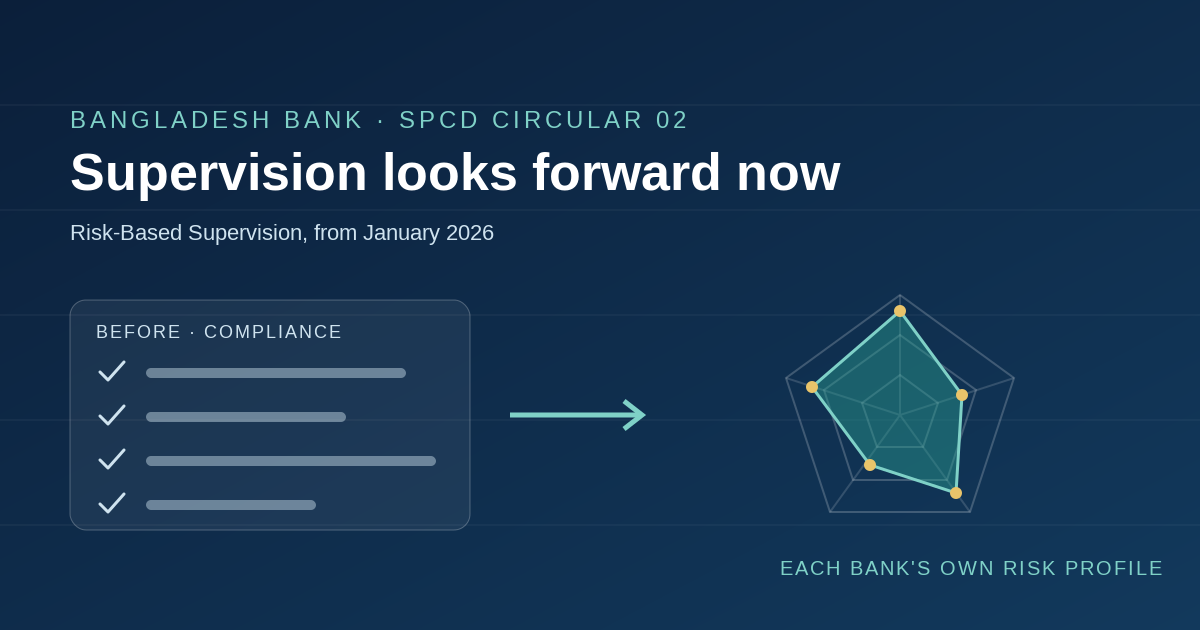
Circular 03 calls traditional compliance-based supervision, which “primarily emphasizes rule-checking and reliance on historical data”, no longer sufficient. RBS is forward-looking, continuous through off-site monitoring and targeted on-site reviews, and proportionate to a bank’s size, complexity and systemic importance. The assessment ends in a bank’s Composite Risk Rating, which sets the intensity, frequency and depth of supervision.
UNB reported that the formal launch was held on Sunday 4 January 2026, after a planned 1 January start was postponed for state mourning. The circular’s effective date remains 1 January.
Who supervises you now
Early press reports disagreed on how many units the reorganisation created: The Business Standard cited 14 new divisions from a December letter. Circular 03 settles it. Bangladesh Bank established seventeen supervisory departments: twelve Bank Supervision Departments (BSD-1 to BSD-12) and five specialised ones.
- Each BSD supervises its banks through a single dedicated team per bank, on and off site, covering areas such as foreign exchange operations and complaint management.
- The Supervisory Data Management and Analytics Department (SDAD) is the central hub for data collection, validation and quality assurance.
- Other specialised departments cover technology risk and digital banking, money laundering and terrorist financing, and payment systems, alongside SPCD.
- Every bank gets a Lead Bank Supervisor as its primary contact, and must name a focal-point official for RBS to liaise with that supervisor and follow up on supervisory letters and risk mitigation plans.
What banks were told to prepare
Circular 02 did not wait for January. It gave banks eight tasks in the three months before launch, ending in a self-assessment report to Bangladesh Bank.
Oct 2025
- Form an RBS coordination committee
Nov 2025
- Gap analysis against expectations
- Board-approved action plan
Dec 2025
- Upgrade MIS and data (RIT template)
- Awareness programmes
- Update policies and manuals
- Realign structure for independence
- Submit self-assessment to BB
Two details stand out. The action plan must be approved by the Board, so this cannot sit in the risk department alone. And the data task refers to a Rationalized Input Template (RIT) already given to banks in a pilot, a first sign of the structured returns covered below.
What the supervisor expects
The annexure to Circular 02 lists the expectations. In my words:
- Governance. The Board and senior management own risk oversight, with a visible tone at the top, a real risk culture, whistleblowing, and three lines of defence.
- Risk appetite. A Board-approved Risk Appetite Framework, with limits cascaded down to business units, products and portfolios.
- Risk identification. Credit, market, liquidity, operational, legal, strategic, ML/TF and technology risks, plus emerging ones such as cyber, climate, third-party and fintech. Stress tests, early-warning indicators, a recovery plan and tested continuity plans.
- Capital and liquidity. ICAAP and stress tests linked to capital planning, and liquidity managed against LCR, NSFR and a tested contingency funding plan.
- Independent control functions. A Chief Risk Officer with a direct line to the Board, and internal audit working on a risk-based approach.
- Data and MIS. Systems that produce “granular, accurate, timely and consistent data across all risk areas”, and compatibility with Bangladesh Bank’s RBS data requirements.
- Open engagement. Complete information for supervisors, and immediate notification of any event that could significantly affect risk profile, liquidity, capital, earnings or continuity.
The returns: 13 structured templates
This is the part most teams will feel day to day. Circular 03, paragraph 9, sets out how data flows to the supervisor:
- Structured data goes through 13 RITs on the e-Returns portal, strictly by the frequency and deadline for each.
- Unstructured reports listed in Annexure 3, such as audited financial statements, the bank’s risk appetite statement and the minutes of the Board, its committees, ALCO and senior management, are uploaded to the same portal. They follow their own prescribed timeline where one exists, and are otherwise submitted as or when updated.
- Returns previously sent to the dissolved departments continue on the same channel and frequency “until further instruction”, with those not already on a web portal now going to SDAD. The transition is phased, so check each return’s governing instruction.
The table lists the 13 templates with their official codes. Every deadline is in the month after the reporting period.
| Return | Official RIT code | Frequency | Due in the following month |
|---|---|---|---|
| Monthly main | T_M_RBS_MAIN |
Monthly | 15th |
| Deposit concentration | T_M_RBS_DEPOSIT_CONCENTRATION |
Monthly | 10th |
| Interbank transaction matrix | T_M_RBS_IB_TRANS_MATRIX |
Monthly | 15th |
| All claims | T_Q_RBS_ALL_CLAIMS |
Quarterly | Last day |
| Past-due exposures | T_Q_RBS_PAST_DUE |
Quarterly | 20th |
| External credit assessment institutions (ECAIs) | T_Q_RBS_ECAIS |
Quarterly | Last day |
| Borrower concentration | T_Q_RBS_BORROWERS_CONCENTRATION |
Quarterly | Last day |
| Defaulter concentration | T_Q_RBS_DEFAULTERS_CONCENTRATION |
Quarterly | 20th |
| Subsidiary information | T_Q_RBS_SUBSIDIARY_INFORMATION |
Quarterly | Last day |
| List of shareholders | T_Q_RBS_LIST_OF_SHAREHOLDERS |
Quarterly | 12th |
| Investment against bonds and commercial paper | T_Q_RBS_INVESTMENT_AGAINST_BOND_CP |
Quarterly | 10th |
| Quarterly main | T_Q_RBS_MAIN |
Quarterly | Last day |
| Quarterly summary | T_Q_RBS_SUMMARY |
Quarterly | 20th |
Note that the monthly and quarterly “main” returns have different deadlines, and so do the borrower and defaulter concentration returns. A reporting calendar that records the template ID, reporting date, due date and owner for each return is easier to keep right.
How a correct total can hide concentration
Suppose a bank records Tk 40 crore of funded exposure to Company A and Tk 30 crore to Company B. Assume the two belong to the same group under the applicable definition. If their customer records carry different group identifiers, the return may show two smaller exposures where the bank should see one Tk 70 crore group exposure.
What the return shows
Group ID G-101
Company A
Tk 40 crore
Group ID G-207
Company B
Tk 30 crore
What the bank should see
One group, one ID
Companies A + B
Tk 70 crore
A balance reconciliation will not catch this, because the total is the same. Only a check of the customer-to-group mapping against approved records will. Deposit concentration is similar: total deposits can barely move while a handful of large customers fund a growing share of the bank.
Why this is a data problem, and what I would do
Circular 03, paragraph 9(E), says banks must ensure the “accuracy, completeness, consistency and timeliness” of all data, and that persistent data-quality deficiencies or material misreporting may be viewed as a failure of governance and internal controls, “leading to punitive measures”. Paragraph 11 adds that failures to comply may lead to regulatory directives. That puts MIS squarely in the supervisory conversation. It is the same theme as my post on expected credit loss: earlier warning depends on data you can trust and trace.
Nothing here is official guidance; it is how I would approach it.
- Map every material field to its source. Record the system, cut-off, unit and business rule behind each figure.
- Agree definitions with data owners. Borrower groups with Credit, deposit groupings with the deposit owner, balances with Finance. Note where one template’s scope differs from another’s.
- Reconcile, then test the detail. Tie totals to the ledger, then look for missing group IDs, duplicate accounts and large movements.
- Keep evidence with each submission. The source extract, mapping version, sign-off, submitted file, portal acknowledgement, and a record of any revision.
- Keep the action plan alive. Bangladesh Bank said it will review progress against it, so someone should own it.
- Rehearse the notification case. Decide in advance who tells the supervisor what, and how quickly.
What I do not yet know
The circulars say assessments culminate in a Composite Risk Rating, but I have not found a published scale or scoring method. UNB also quotes unnamed officials saying outcomes may range from management changes to use of the Bank Resolution Ordinance. That is a report, not a published rule. If you work on RBS readiness in a Bangladesh bank and see it differently, I would like to hear how.
Sources: Bangladesh Bank, SPCD Circular No. 02, 23 October 2025 and SPCD Circular No. 03, 24 December 2025; The Business Standard, 16 December 2025; UNB, 4 January 2026. The borrower example uses fictional figures. Read the circulars themselves before relying on any detail here.