Expected Credit Loss Is Coming to Bangladesh Banks. Here Is What Changes.
· 4 min read · Banking, IFRS 9, Credit risk, Bangladesh
I work in banking, so I spend a lot of time around loan data. In March 2026 Bangladesh Bank issued a guideline that will change what that data has to answer. This post is my plain-language reading of it, written for colleagues and for anyone outside banking who is curious. It is my own view, not an official position.
The shift in one sentence
Today, provisions in Bangladesh mostly follow an incurred loss approach: a bank sets money aside once a loan has visibly gone bad. The new guideline, based on IFRS 9, moves banks to expected credit loss (ECL): set money aside based on what you expect to lose, before the loan goes bad.
According to The Daily Star’s report on the guideline, banks must adopt the ECL model for funded and non-funded credit facilities from 1 January 2028, and for other financial instruments from 1 January 2029.
- Mar 2026Guideline issuedBangladesh Bank publishes its IFRS 9-based ECL guideline.
- 2026–2027The runwayTime to map data, write policy and run shadow staging.
- 1 Jan 2028Credit facilitiesECL applies to funded and non-funded credit facilities.
- 1 Jan 2029Other instrumentsECL extends to other financial instruments.
The three stages
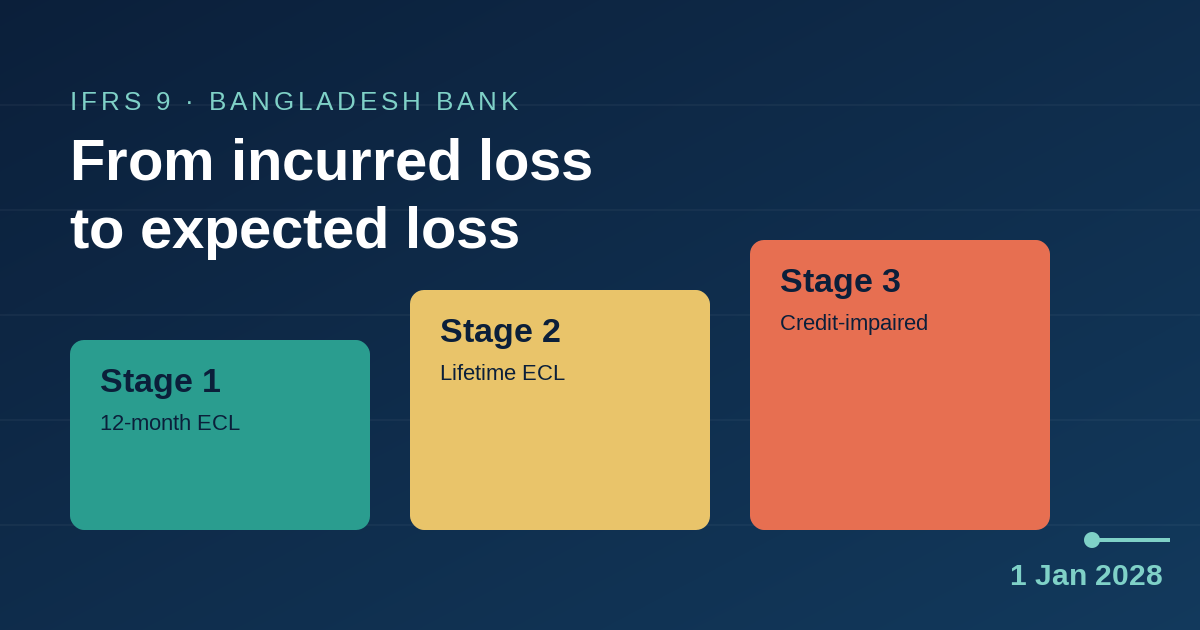
IFRS 9 sorts exposures into three stages, and the stage decides how much provision a bank holds.
- Stage 1: performing. No significant rise in credit risk since the loan was made. The provision covers losses expected over the next 12 months.
- Stage 2: significant increase in credit risk. The loan is not in default, but something has clearly worsened. The provision covers losses expected over the whole life of the loan.
- Stage 3: credit-impaired. The loan has defaulted or is otherwise impaired. Lifetime losses apply, and interest is typically measured on the net amount.
Incurred loss · today
Expected credit loss · from 2028
The important change is stage 2. Under an incurred-loss approach there is no natural place for “this loan is worrying but not yet late”. ECL creates one, and that is where earlier warning is supposed to come from.
Three things that are genuinely new
1. Forward-looking inputs. The guideline expects banks to reflect macroeconomic conditions such as GDP growth, inflation and interest-rate trends when assessing credit risk. A provision is no longer only a function of days past due. It becomes partly a view about the economy.
2. Off-balance-sheet exposure. Provisioning extends to loan commitments, guarantees and unused credit lines, not only funded loans. For banks with large trade-finance books, this matters. Guarantees and letters of credit sit outside the loan ledger, so in general they can be tracked in different systems from funded loans.
3. Judgement that has to be explained. Deciding what counts as a “significant increase in credit risk” is a policy choice, not a lookup. Banks will need defensible rules, documented, and applied consistently.
Where the real work is: data
In my view the model itself is rarely the hard part. The hard part is the data underneath it.
- Can you reconstruct a borrower’s history, not just their current status? Staging depends on comparing today’s risk with the risk at origination.
- Are funded and non-funded exposures to the same customer linked? Often they live in separate modules.
- Is collateral recorded in a form a model can use, rather than only in a document?
- Can you re-run last month and get the same answer? Auditors will ask.
- Rating historyRisk at origination and today
- Funded loansBalances and days past due
- Non-funded exposureGuarantees, LCs, unused limits
- CollateralIn a form a model can use
- Economic outlookGDP, inflation, interest rates
Staging and ECL model
Stage 1, 2 or 3, then 12-month or lifetime loss
Provision
Reconciled to the general ledger and repeatable for audit
Core banking systems were built to record transactions, not to replay the history of a credit decision. Closing that gap is mostly data engineering and careful reconciliation, which is unglamorous and takes time.
What I would do now, as a practitioner
Nothing here is official guidance; it is simply how I would approach a long runway.
- Map the data. For each exposure type, list where the origination rating, current rating, days past due and collateral actually live.
- Run a shadow staging exercise. Even a rough stage 1/2/3 split on a past month shows quickly where data is missing.
- Write down the stage 2 triggers early. Policy debates take longer than coding.
- Reconcile to the ledger from day one. A model that cannot tie back to the general ledger will not survive review.
I use the same habit in my own tools. For example, Portfolio Pulse turns month-end loan workbooks into management reports using synthetic data in public and local processing in practice. That experience makes one thing clear: a number that cannot be traced back to its source is not ready to be relied on.
Why a long runway is a gift
January 2028 is more than a year away. That is enough time to do this carefully, and not enough time to leave it alone. The banks that treat the next year as a data project, not a modelling project, will have the easiest transition.
I will write more on this as the details settle. If you work on ECL in a Bangladesh bank and see it differently, I would like to hear how.
Sources: The Daily Star, “BB to overhaul loan classification system from 2028”, 8 March 2026. Read the guideline text itself on Bangladesh Bank’s website before relying on any detail here.